


Manual Handling – How’s Your Technique?
Test
Ask an employee to explain good lifting techniques. Also check there is no unnecessary manual handling.
Reason for This Question
Staff must not be allowed to carry out any manual handling tasks without having had manual handling training.
Possible Answers
Red: Staff could not demonstrate safe lifting techniques
Amber: Staff able to demonstrate safe handling, but no training records found
Green: Staff able to demonstrate safe handling and good training records in place
Common Issues
No training records available.
Observations saw many examples of poor manual handling techniques.
Processes not documented
Manual handling training is provided as part of induction however but no refresher training.
Fail Rate
18% of businesses failed this question based on our sample data.
Information
What is manual handling?
Manual handling is defined as “The supporting and transporting of a load by hand or bodily force”
Lifting or lowering
Carrying
Pulling
Pushing
Under the Manual Handling Operations Regulation 1992 it is every employer’s duty to carry out a risk assessment for each manual handling task or activity.
Before completing a risk assessment as employer you need to ask:
Can this activity/task be eliminated? Does it have to happen?
Manual handling policy
It should be policy that all team members receive manual handling training on induction and training prior to commencement of any duties involving manual handling.
Poor manual handling is one of the biggest single causes of injuries in the workplace.
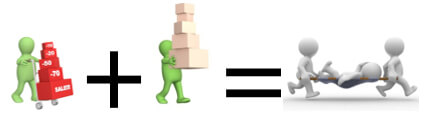
Injuries include pulled muscles and strains, damage to the structure of the back, damage from dropping loads onto feet or trapping hands between loads and fixtures, and falls when trying to move loads.
Examples of manual handling include:
Lifting stock up to and down from stockroom racking,
Carrying stock into a stockroom area from a delivery vehicle,
Pushing or pulling out a trolley,
Putting out the waste,
Handling equipment that needs to be physically moved.
High Risk Activities
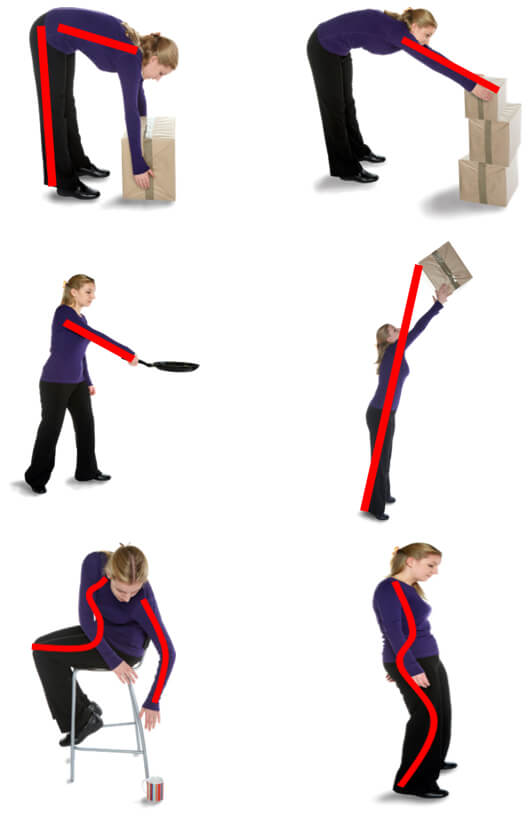
Good manual handling practices can help to prevent and minimise accidents and injury.

People are different!
The ability to carry out physical work such as manual handling will vary between employees, e.g. with age, sex, fitness, etc. and also for the same person over time, e.g. as they age, become more or less fit, suffer injuries or illness.
Never assume that everyone is capable of a particular task,
In general, young persons, females, less physically fit persons, and team members with lighter physiques can handle fewer loads, in a safe manner, than a mature, male, fit, physically strong person.
Certain conditions can make persons more susceptible to manual handling injuries, even if they might otherwise be considered likely to be capable of a particular task. These include:
pregnancy and nursing,
any existing upper limb problems,
any existing back problems,
Hernia, etc.
Safe Manual Handling Guidance
If possible manual handling of loads will be avoided altogether.
It is unlikely that all manual handling can be avoided but it might be possible to remove the need for some tasks.
If handling cannot be avoided use of mechanical aids should be considered to reduce the amount of physical effort required.
For a specific task then management will need to complete a task specific lifting and carrying risk assessment form or the task specific pushing and pulling risk assessment form which is held in the health and safety records folder or can be printed from PYRAMID™ under the health and safety menu ->health and safety records option.
Any team member who feels they have any impairment that may affect an ability to carry out manual handling safely, should inform their duty manager.
Where team members will have to use physical effort in manual handling the following general precautions must be followed:
Anyone carrying out manual handling will be trained in good handling technique,
Individuals must not attempt to handle loads that are beyond their capabilities,
If necessary, loads should be broken down to a more manageable weight, especially in cases where help from another team member is not available,
Help should always be sought from other team members to move heavy or awkward objects that cannot be split into smaller, or more manageable, loads. These team members must be briefed on the findings of the risk assessment.
Sensible footwear which gives a good grip and allows for good balance must be worn.
How to avoid manual handling:
Does it need to be moved?
Can contractors be used?
Contact your management if issues arise and that cannot be resolved.
Smaller and more manageable loads/products.
Can the items be taken direct to their storage area or point of use by the deliverer?
Can the distance travelled be reduced or be made safer or easier to move things through?
Good Handling Technique – General Lifting
Think before lifting/handling and plan the lift
Can mechanical aids be used?
Will help be needed with the load?
Can the load be broken down and carried as a number of smaller loads?
Examine the route to be taken; is it well lit, are there steps or changes in level, are there any obstructions or trip hazards that need to be moved out of the way, etc.
For a long lift, consider resting the load midway on a table or bench to change grip.
Look at where the load is to be moved to. Can it be put down safely and easily or is there any need to move other items to create space?
Are there any sharp edges on the load? If so cover them or wear protective gloves.
If the load needs to be lifted by straps, are gloves needed to stop these cutting into hands?
Can the weight in the load move around, e.g. a liquid in a part full container? Unstable loads will be more difficult to handle so the safe maximum load for each person will be reduced.
Is there anything about the load that might make it difficult to move safely?
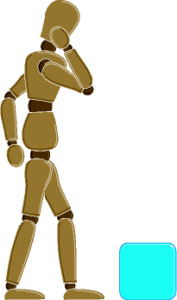
Adopt a stable position

The feet should be apart with one leg slightly forward to maintain balance (alongside the load, if it is on the ground).
Try to stand close enough to the load to have the centre of weight of the load as close as possible to the body. If the load is on the floor placing feet to the sides of the load can help (having feet square against one side will ‘push you away’).
Be prepared to move their feet during the lift to maintain a stable and balanced position.
Avoid tight clothing or footwear which may make this difficult